Dougga (Thugga): Roman Ruins, Visitor Guide & Entry Fees
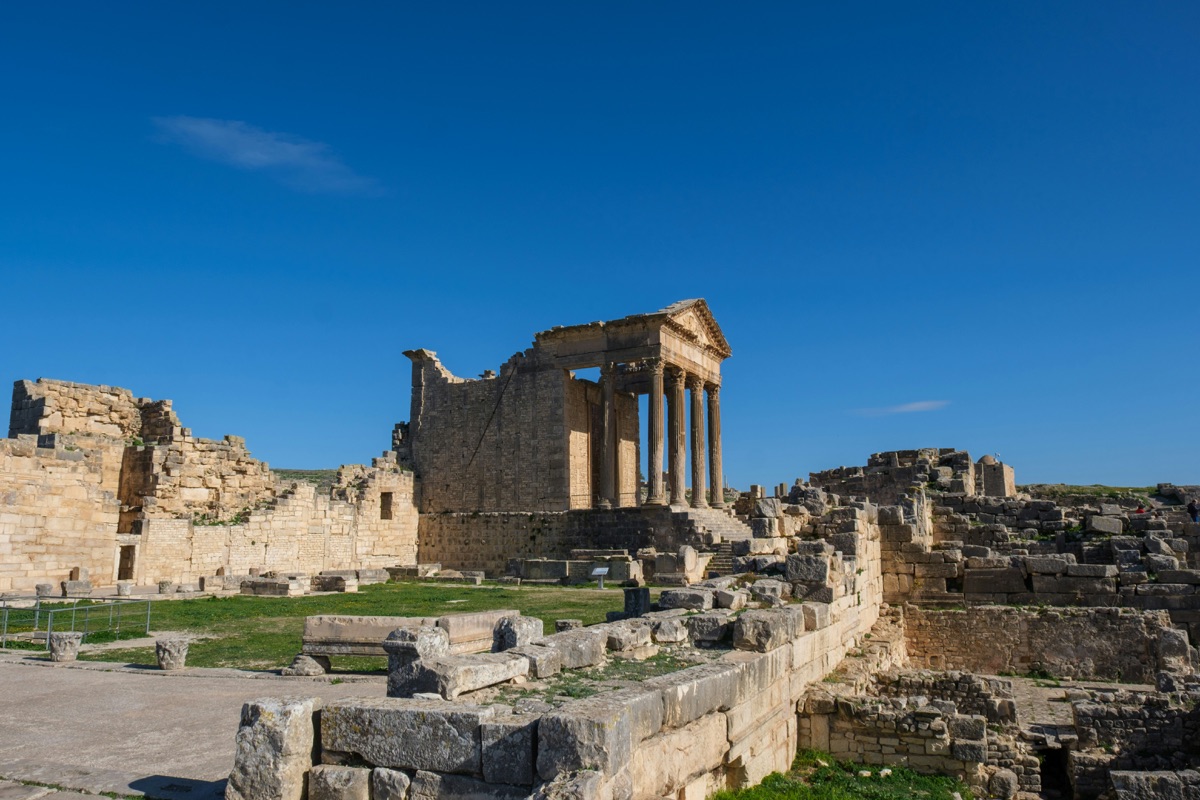
Dougga — known to the Romans as Thugga — is one of the most remarkable archaeological sites in North Africa. Situated on a hillside in northwestern Tunisia, overlooking a wide valley of olive groves and farmland, it has survived largely intact because it was never built over in later centuries. UNESCO inscribed the site in 1997, recognising it as the best-preserved Roman small town in North Africa.
Unlike Carthage, which was destroyed by Rome in 146 BC and rebuilt as a Roman city, Dougga preserves a more organic urban fabric: narrow streets, public buildings, private houses, and temples layered over a pre-Roman Numidian town. The result is one of those rare sites where the historical imagination does not have to work hard. The Capitol still stands. The theatre still has most of its seats. The streets are still paved.
Getting to Dougga
Dougga sits 120 km southwest of Tunis, near the town of Téboursouk in the Béja governorate. There is no direct public transport to the site itself, which is part of why it remains less crowded than Carthage or El Jem.
Hire car: The most flexible option. The route from Tunis via the GP5 motorway to Téboursouk takes approximately 1 hour 45 minutes to 2 hours depending on traffic. A hire car also allows you to combine Dougga with nearby Thuburbo Majus or Bulla Regia on the same day. See our Tunisia car rental guide for operators and pricing.
Organised day tour: Several operators in Tunis run day tours to Dougga, typically combined with another site such as Bulla Regia. These cost from approximately 80–150 TND per person as of 2026, with transport and a guide included. For context on available tours, see the day trips from Tunis guide. You can also check current tours from Tunis for operators who cover the northwestern circuit.
Louage: Louages (shared taxis) run from Tunis Bab Saadoun station toward Téboursouk (approximately 12–15 TND per seat, around 2.5 hours). From Téboursouk, a private taxi to the Dougga site costs around 5–8 TND each way. This is the budget option, but timing return transport can be unpredictable.
Entry and practicalities
- Entry fee: Approximately 15 TND (around €4.50 as of 2026). Children under 12 enter free.
- Opening hours: 8:30–17:30 (winter, October–March); 8:00–19:00 (summer, April–September). Closed on public holidays.
- On site: There are toilet facilities near the main entrance. A small drinks vendor operates at the site entrance in high season. No restaurant — bring water, especially in summer. The site sells a guide booklet for approximately 5 TND.
- Photography: Permitted throughout the site for personal use. No tripod restrictions, though commercial photography requires separate authorisation.
- Accessibility: The site is on a hillside with uneven Roman paving. It is not wheelchair accessible in most areas. Comfortable, closed-toe shoes are essential.
What to see at Dougga
The Capitol
The Capitol is Dougga’s most iconic structure: a temple dedicated to the triad of Jupiter, Juno, and Minerva, built in AD 166–167 and paid for by a wealthy local family, the Marcii. Six Corinthian columns support a pediment carved with reliefs showing the apotheosis of the deified emperor Antoninus Pius. The columns are approximately 8 metres tall and still hold their entablature.
Stand in the forum below and look up at the Capitol to understand the scale. The entire structure was designed to be seen from this approach — the visual impact is immediate. This is one of the best-preserved Roman temple facades anywhere in the Mediterranean world.
The Roman Theatre
The theatre at Dougga was built in AD 168–169, also at the expense of the Marcius family. Cut into the hillside in the standard Roman style, it originally seated approximately 3,500 spectators on 19 semicircular tiers of seating. The stage wall (scaena) is partially restored; the cavea (seating area) is largely intact.
The view from the upper tiers of the theatre is one of the best at Dougga: the forum, Capitol, and the surrounding olive groves spread out below. In June, the theatre hosts the Dougga Festival, an annual performing arts event with music and theatre staged within the ancient structure — an atmospheric setting with performances against the backdrop of the lit ruins.
The Libyco-Punic Mausoleum
Near the southern edge of the site stands the Libyco-Punic Mausoleum, a multi-tiered funerary monument believed to date from around the 2nd century BC — pre-Roman and one of the few surviving examples of Numidian monumental architecture. The mausoleum was partially dismantled in the 19th century when a British consul removed a bilingual Libyco-Punic inscription (now in the British Museum), which helped scholars decipher the previously unknown Libyan script. The structure has since been reconstructed.
Baths, temples, and domestic houses
The Licinian Baths (3rd century AD) are among the largest in Roman Tunisia and preserve significant mosaic floors, though the mosaics have mostly been moved to the Bardo Museum in Tunis. The baths complex gives a clear sense of the scale of Roman public bathing infrastructure.
The Temple of Saturn occupies the site of an earlier Baal Hammon sanctuary, reflecting the layering of religious sites characteristic of North African Roman cities. The Temple of Juno Caelestis (early 3rd century AD) sits in a distinctive semicircular temenos (sacred precinct) and is one of the better-preserved religious structures on site.
The residential areas include the House of the Trifolium, a large 3rd-century AD dwelling with a mosaic floor. Walking through the domestic streets — some still partially roofed by surviving walls — gives a rare sense of scale for a private home in a Roman provincial town.
Best time to visit
October–March is the ideal period. The site is comfortable to walk for several hours, the surrounding valley is green, and crowds are minimal. November and December are particularly good — the autumn light is warm and golden, and most tour groups have stopped running.
April–September: Dougga is accessible but hot. In July and August, the exposed hillside becomes extremely warm by 10am. If visiting in summer, arrive as close to opening time as possible and plan to leave by midday.
Spring (March–April): The valley below Dougga is covered in wildflowers and the olive groves are in leaf. A genuinely beautiful backdrop for the ruins that is absent in the baked-dry summer months.
Combining Dougga with other sites
A hire car makes it straightforward to visit multiple northwestern Tunisia sites in a single day:
- Bulla Regia (90 km from Dougga): Another exceptional Roman site, famous for its underground houses built to escape summer heat. Allow 1.5–2 hours.
- Thuburbo Majus (about 65 km southeast of Dougga, between Dougga and Tunis): A large Roman city with well-preserved forum and Capitol. Allow 1–1.5 hours. Useful for breaking the drive back to Tunis.
- Chemtou (50 km northwest of Dougga): Quarries of the famous Numidian yellow marble (giallo antico) with an associated museum and Roman bridge. Lighter on standing architecture but unique for its stone history. Allow 1–1.5 hours.
What to bring
- Water: At least 1.5 litres per person, more in summer. On-site vendors are unreliable.
- Sunscreen and hat: The site offers almost no shade. SPF 50+ is not excessive.
- Comfortable shoes: Roman paving is uneven. Sandals are not ideal.
- Cash: Entry is cash only. The nearest ATM is in Téboursouk.
- A guide booklet or downloaded map: The site is large and not always well signposted. The on-site booklet (approximately 5 TND) is worth buying at the entrance.
Context: why Dougga survived
Most Roman towns in North Africa were built over in later centuries as populations stayed and cities grew. Dougga’s survival is partly due to the fact that the medieval and Ottoman-period population lived in a separate village (Téboursouk) rather than reusing the Roman stone as building material on the same site. The town was formally inhabited until the 1960s, when the Tunisian government relocated the remaining residents to facilitate archaeological work. This is why the site feels so coherent: it was not stripped or built over.
The site’s scale — 70 hectares, over 2,000 years of occupation, Numidian through Roman through Byzantine — makes it a genuinely unusual place. For anyone travelling in Tunisia with an interest in archaeology, it ranks alongside El Jem and Carthage as essential.
For transport options to reach Dougga independently, see the getting around Tunisia guide. For details on safety and practical preparation, see the Tunisia safety guide. Dougga features on the Day 4 route of our 10 days in Tunisia itinerary and can also be done as a standalone excursion from Tunis — see our day trips from Tunis guide. A hire car is the most practical way to reach Dougga independently and explore the wider northwest region at your own pace.
Frequently Asked Questions
- What is Dougga?
- Dougga (ancient name Thugga) is a UNESCO World Heritage Site in northwestern Tunisia — one of the best-preserved small Roman towns in North Africa. The site covers approximately 70 hectares and contains a Capitol temple, theatre, forum, baths, mausoleums, and thousands of surviving architectural elements.
- How do you get to Dougga from Tunis?
- Dougga is approximately 120 km from Tunis (around 2 hours by car). There is no direct public transport to the site. The practical options are a hire car, an organised day tour from Tunis, or a louage to Téboursouk (the nearest town, 6 km away) followed by a taxi or on-foot approach.
- What is the entry fee for Dougga?
- Entry to Dougga costs approximately 15 TND (around €4.50 / £4 as of 2026). The fee covers access to the full archaeological site. Children under 12 enter free. Prices are set by the Tunisian National Heritage Institute (INP) and are subject to change.
- What are the opening hours for Dougga?
- Dougga is open daily from approximately 8:30 to 17:30 in winter (October–March) and 8:00 to 19:00 in summer (April–September). The site is closed on public holidays. Arrive early to avoid the midday heat and to have the ruins to yourself before any tour groups arrive.
- How long does it take to visit Dougga?
- A thorough visit takes 2–3 hours at a comfortable pace. The site covers a significant area and involves walking on uneven ground. In summer, visiting in the early morning is strongly advisable — the exposed stone amplifies heat and there is little shade.