Things to Do in Sousse — Ribat, Medina, and Port El Kantaoui
Upcoming Events in Sousse
- Carnival of Awussu
Annual summer carnival along Sousse's Habib Bourguiba Street, with a grand parade of floats, brass bands, folk dancers, and international delegations.
Sousse is Tunisia’s third-largest city and one of its most historically layered. The medina — a UNESCO World Heritage Site since 1988 — contains two of the finest examples of early Islamic military architecture in the Maghreb: the Ribat fortress and the Great Mosque. Beyond the old walls, Port El Kantaoui offers a different register entirely: a purpose-built resort marina that is one of the best-maintained on the North African coast.
This guide covers the main things to do, from the historical core to the beach resort strip, with current entry fees, opening hours, and practical logistics.
The Ribat of Sousse
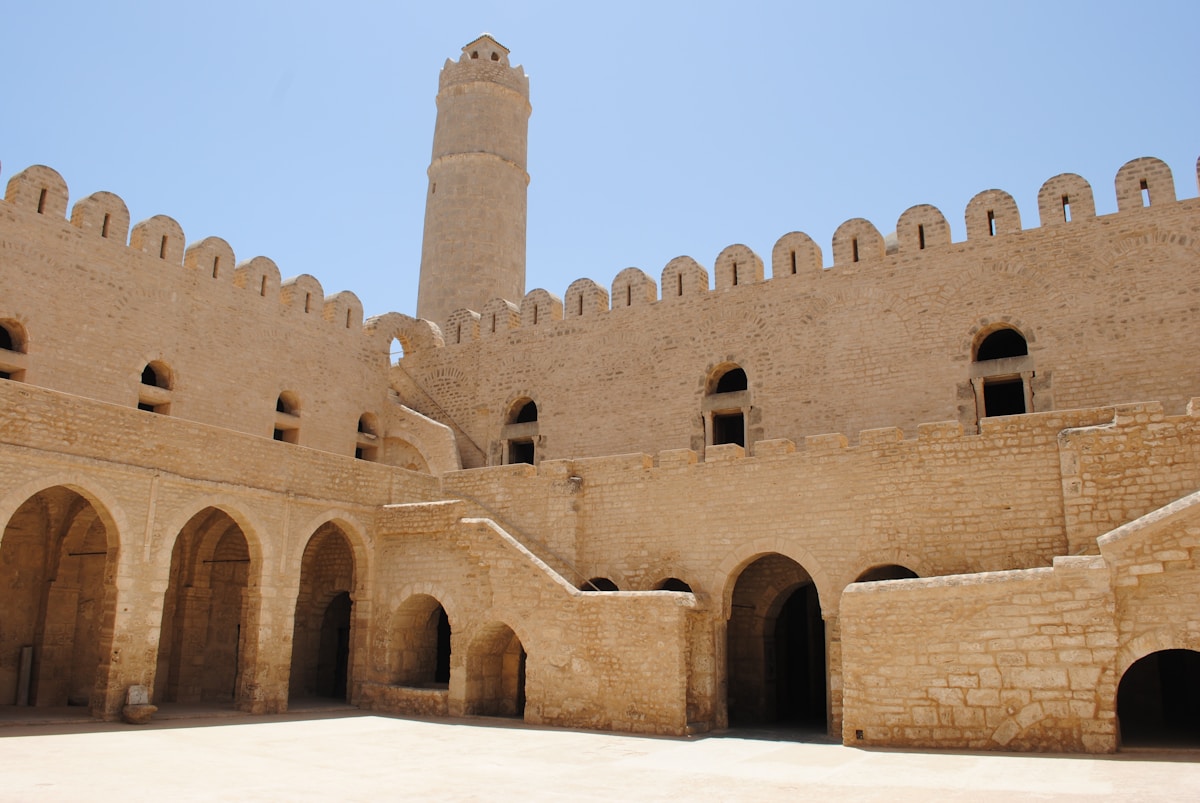
The Ribat is the oldest and most impressive monument in the medina, built in 787 CE by the Aghlabid emir Harthama ibn A’yan as a ribat — a fortified monastery used by warrior-monks (murābiṭūn) who simultaneously defended the coastal frontier and practiced Islamic devotion.
The structure is a large square enclosure with a round watchtower (the nador) at the northeast corner. Inside, the courtyard is surrounded by two levels of arched galleries. The cells and prayer halls preserve carved plaster and wooden elements rare for their age in North Africa. The watchtower is open to visitors who climb to the top for a panoramic view of the medina rooftops, the Great Mosque next door, and the sea.
- Entry: approximately 8 TND per person as of 2026, including access to the watchtower
- Opening hours: Tuesday–Sunday, 8am–7pm (summer, April–October); 8:30am–5:30pm (winter). Closed Mondays.
- Location: Place de la Grande Mosquée, at the northeastern edge of the medina
- Photography: permitted throughout; the watchtower view is the best shot in Sousse
Allow 45 minutes to an hour. The Ribat is compact but requires time to take in the carved details and the view.
The Great Mosque of Sousse
Adjacent to the Ribat, the Great Mosque (Mosque of Sousse) was founded in the 9th century and expanded under various dynasties. Its courtyard — a large open space surrounded by marble columns salvaged from Roman Hadrumetum (the ancient city beneath modern Sousse) — is one of the most serene spaces in the medina.
Non-Muslim visitors are welcome in the courtyard but not the prayer hall. Dress modestly (shoulders and knees covered). No admission charge for the courtyard; modest donations are accepted.
Medina of Sousse — UNESCO World Heritage
The medina was inscribed as a UNESCO World Heritage Site in 1988, recognised for its “outstanding universal value” as an almost-complete example of early medieval Islamic urban planning. Unlike the medinas of some other Tunisian cities, Sousse’s medina retains most of its original street pattern, the positions of its old gates (Babs), and the traditional separation between residential and commercial quarters.
The main souk street runs from the Ribat area toward the central market, flanked by workshops selling leather goods, pottery, and spices. Side lanes lead to residential quarters where the architecture remains largely unchanged from the 10th century.
Key points within the medina:
Kasbah Museum: The Kasbah (citadel) at the southwestern corner of the medina houses Sousse’s principal archaeological museum. The collection covers Punic and Roman Hadrumetum through to the Byzantine and early Islamic periods. Roman mosaics are the highlight — Sousse’s floor mosaics are among the finest surviving outside Tunis’s Bardo Museum. Entry approximately 8 TND as of 2026, open Tuesday–Sunday.
Bab el Ghabli: The southern gate of the medina, dating from the 9th century, is one of the few original gates still standing and is a useful orientation point when navigating the southern medina streets.
Souks: The covered souks between the Great Mosque and the Kasbah contain workshops and retail selling traditional crafts. Prices are negotiable. Beware the tourist-grade ceramics sold at higher prices near the main entry points — the workshops deeper in the medina often sell better quality work at lower prices.
Catacombs of Sousse
The Catacombs of Sousse are a Roman-era burial complex dating from the 2nd to 5th centuries CE, cut into the limestone beneath the city. At the time of their use, Sousse (then Hadrumetum) was a significant Roman provincial city, and the catacombs served both the local Roman population and early Christian communities.
The accessible section runs for several hundred metres of carved tunnels, with burial niches (loculi) cut into the walls on both sides — thousands of tombs in total. The air is cool and the passages are narrow. An on-site museum displays grave goods, oil lamps, and inscriptions from the excavations.
- Entry: approximately 5 TND as of 2026
- Opening hours: Tuesday–Sunday, 9am–4pm (shorter in winter). Call ahead as hours are occasionally reduced without notice.
- Location: About 1 km west of the medina, near Avenue Habib Bourguiba
This is a specialist interest but worth the 90 minutes if Roman archaeology is your focus.
Port El Kantaoui — Marina Resort
Port El Kantaoui is Tunisia’s most polished purpose-built resort, constructed in the 1970s and 1980s around a landscaped marina on the coast 10 km north of Sousse. It is not a “real” place in the sense that the medina is — no local community lives here, and the architecture is broadly Mediterranean pastiche. But it executes what it is trying to do well.
The marina is clean, the promenade is pleasant, and the concentration of cafés, restaurants, and water sport operators means it is a practical option for a half-day afternoon visit. Boat trips around the bay, parasailing, and jet skiing are all available from the marina jetties at standard tourist pricing (boat trips approximately 40–70 TND per person as of 2026).
Golf: Port El Kantaoui has two 18-hole golf courses (Port El Kantaoui Golf Club) on a manicured hillside behind the marina. Green fees approximately 120–160 TND per round as of 2026. Rental clubs available.
Getting there: Taxis from central Sousse cost approximately 15–20 TND one way. Local buses also run the route (roughly 1 TND), departing from Avenue Habib Bourguiba.
Beaches
Sousse’s urban beaches are in the resort strip north of the port. The main public beach (directly accessible from the city) is free but crowded in high season (July–August). The better beaches are at the hotels north of the city and around Port El Kantaoui, where the water is cleaner and the beach infrastructure more managed.
Practical Notes
Getting to Sousse: From Tunis, trains run regularly from Tunis Gare Centrale and take approximately 2 hours (fare approximately 15 TND as of 2026). Louages from Tunis to Sousse depart from the Bab Alioua station and are slightly faster (1h 30min in light traffic).
Getting around Sousse: The medina, Ribat, and Kasbah are all within walking distance of each other. Port El Kantaoui requires a taxi or bus.
When to visit: April–June and September–October for comfortable temperatures without peak-season crowds. July–August is very hot and the beach resorts are at maximum capacity.
Combine with: El Jem (60 km south, Roman amphitheatre), Kairouan (60 km west, Islamic holy city), or Monastir (20 km south, Bourguiba mausoleum and Ribat).
For where to sleep, see our where to stay in Sousse guide. If you’re choosing between coastal bases, our Tunis vs Sousse comparison and Monastir vs Sousse guide set the options side by side. Browse Tunisia tours that include Sousse alongside Kairouan and El Jem for an organised central Tunisia heritage day.
Frequently Asked Questions
- What is Sousse's most important historical site?
- The Ribat of Sousse is the defining monument — an 8th-century Islamic fortress that anchors the UNESCO-listed medina. It was built as a fortified monastery for warrior-monks and its watchtower offers the best elevated view of the medina and sea.
- How long do you need in Sousse?
- A full day covers the main historical sites: Ribat, Great Mosque, Kasbah Museum, and a walk through the medina. Add half a day for Port El Kantaoui if you want the resort marina experience. The catacombs are a specialist interest but add only 90 minutes.
- Is Sousse safe for tourists?
- Yes. Sousse is one of Tunisia's most established tourist cities with a well-developed infrastructure for international visitors. The resort areas and medina are both accessible and generally comfortable. As in any city, normal awareness is sensible in busy market areas.
- Can you combine Sousse with El Jem in a day?
- Yes — El Jem is 60 km south of Sousse (about 1 hour by car or louage). A morning in the Sousse medina followed by an afternoon at El Jem's Roman amphitheatre is a reasonable day trip, though both sites are better with more time.
Book Tours & Experiences in Tunisia
Find guided day trips, Sahara tours, cultural circuits, and city experiences — all bookable online before you arrive.
Browse tours on GetYourGuide →Best price guaranteed — same price as booking direct. We earn a small commission at no extra cost to you.