Things to Do in Kairouan — Great Mosque, Aghlabid Basins and Medina
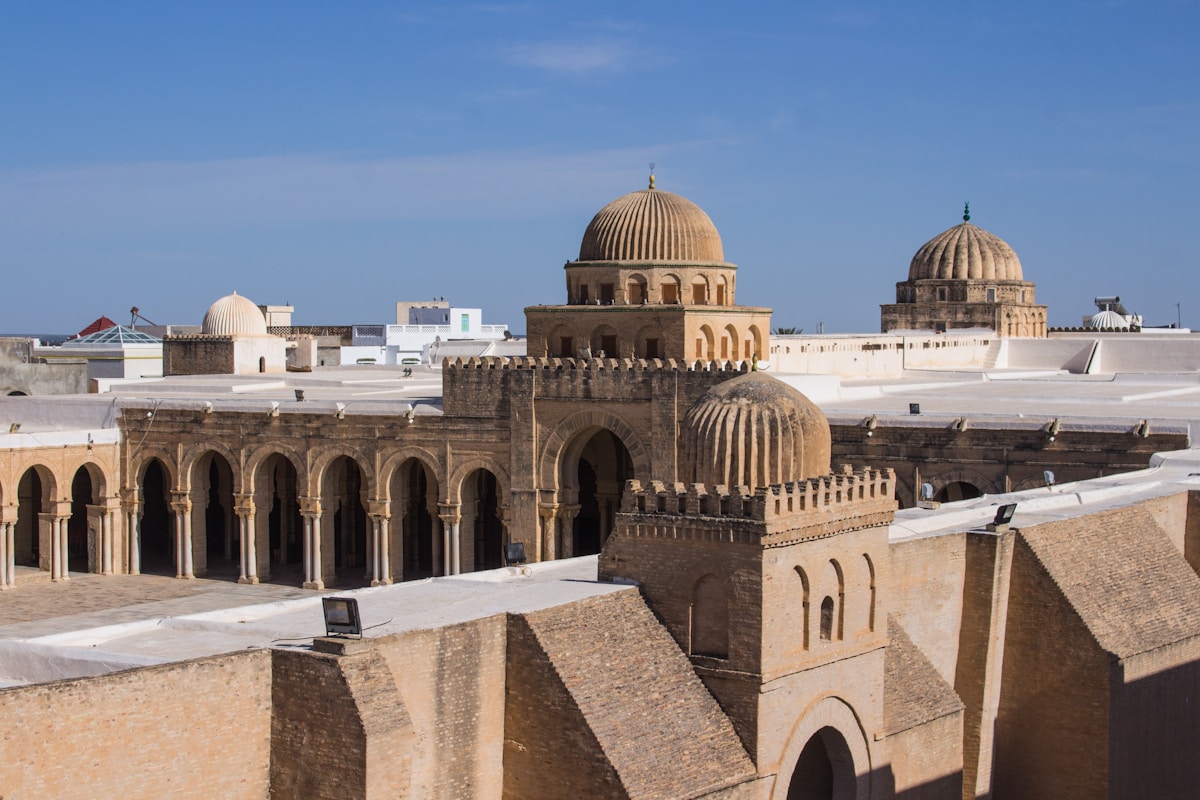
Kairouan is Tunisia’s holy city and one of the most important cities in the history of Islamic civilisation. Founded in 670 CE by Uqba ibn Nafi as the first Arab city in the Maghreb, it served as the capital of the Aghlabid dynasty (800–909 CE) and the base from which Islam spread westward into North Africa and across the Strait of Gibraltar into Europe. It is considered the fourth holiest city in Sunni Islam, after Mecca, Medina, and Jerusalem, and its Great Mosque is one of the oldest and most architecturally significant in the world.
For visitors, it is a compact and walkable city with a remarkable concentration of Islamic monuments, a well-preserved medina, and a food culture built around a single extraordinary pastry. A day here changes the experience of the rest of Tunisia.
The Great Mosque of Kairouan (Mosque of Uqba)
The Great Mosque (Djama el-Kebir) is the most important monument in North Africa after the Pyramids of Giza and the reason that Kairouan sits on every serious Tunisia itinerary. Founded in 670 CE and reaching its current form under the Aghlabid ruler Ibrahim Ahmad II in the 9th century, it is the oldest surviving mosque in the Maghreb.
The plan is a large open courtyard — approximately 70 by 50 metres — surrounded on three sides by covered arcades. The south wall, which faces Mecca, is the qibla wall, fronted by the prayer hall hypostyle — a vast interior space supported by 414 columns salvaged from Roman, Byzantine, and early Islamic buildings across the region. Each column is slightly different: grey marble, red granite, yellow Carthaginian stone, columns taken from Roman temples and Christian basilicas reused in a Muslim building.
The minaret is the oldest surviving example in Islam — three ascending stories of different dimensions, built from Roman-period cut stone, topped with a small domed pavilion. It is not open for visitors to climb.
What non-Muslim visitors can see: The courtyard, the external arcades, and the hypostyle halls viewed from the courtyard opening are fully accessible. The sanctuary proper (the prayer hall interior with the famous 9th-century minbar and mihrab) is restricted to Muslims.
- Entry: approximately 8 TND per person as of 2026 (often sold as a combined medina ticket at the main entrance kiosk outside the mosque)
- Opening hours: Daily, broadly 8am–6pm (shorter in winter; closed during Friday noon prayer — avoid visiting 11:30am–2pm on Fridays)
- Dress: Shoulders and knees covered; women cover hair at the threshold. Shoe removal required in certain areas.
- Location: Centre of the medina, the dominant landmark visible from most approaches
Allow at least 45 minutes to an hour. The scale of the colonnaded interior, viewed from the courtyard doorway, takes time to register.
The Aghlabid Basins
The Aghlabid Basins (Bassins des Aghlabides) are a pair of water reservoirs constructed in the 9th century by the Aghlabid dynasty to supply Kairouan with drinking water channelled from the hills north of the city. The larger basin is approximately 128 metres in diameter — one of the largest hydraulic engineering works of the medieval world.
The engineering is remarkable even by modern standards: a settling basin feeds into the main storage basin via a filtration tower, and the system was designed to remain in use for months without maintenance. The Aghlabid caliphs are said to have used the smaller basin as a pleasure lake.
The basins are no longer in use, but the stone structures survive intact and in excellent condition. There is a small park around the exterior.
- Entry: approximately 3 TND as of 2026 to the park area; the basins are also clearly visible from the road
- Opening hours: Daily, approximately 8am–6pm
- Location: About 500 metres north of the medina walls, on the road toward the main mosque approach
This is a quick stop (30 minutes) but genuinely impressive. The scale of the masonry and the vision behind the project are easier to appreciate in person than in photographs.
The Medina of Kairouan
The medina of Kairouan is among the oldest continuously inhabited medinas in North Africa and is listed as a UNESCO World Heritage Site. Unlike the medinas of Tunis or Sousse, it has relatively few tourists outside of the Great Mosque area, which gives the deeper lanes a more ordinary working-city quality.
The main souk street runs from the mosque area toward the Bab Tunis (northern gate), lined with textile merchants, leather workshops, and the makroudh (pastry) shops that are Kairouan’s most famous commercial product.
Carpet industry: Kairouan is also the traditional centre of Tunisian hand-knotted carpet production. The city’s carpet weaving school (ONAT workshops) and independent family ateliers are distributed through the medina. Carpets sold here are typically genuine hand-knotted work at lower prices than in tourist shops in Tunis or Djerba — a medium-quality Kairouan carpet (approximately 100 by 150 cm) runs from approximately 300 TND at workshop prices as of 2026.
Bir Barouta: A camel-powered well inside the medina, visited primarily for the tradition that its water connects underground to the ZamZam spring in Mecca. The camel walks in a circle to turn the wheel mechanism. Entry approximately 2 TND as of 2026 — a brief but atmospheric stop.
Zaouia of Sidi Sahbi (Barber’s Mosque)
The Zaouia of Sidi Sahbi is a religious complex housing the tomb of one of the Prophet Muhammad’s companions, Abu Zamaa al-Balawi, who is said to have carried three hairs from the Prophet’s beard. The zaouia (a religious school and shrine complex) dates to the 17th century and is decorated with some of the finest Andalusian-influenced tilework in Tunisia — the exterior courtyards are entirely lined with geometric zellige from floor to ceiling, topped with carved plaster panels and painted cedarwood ceilings.
Non-Muslim visitors may enter the courtyard but not the sanctuary containing the tomb.
- Entry: approximately 5 TND as of 2026
- Opening hours: Daily, broadly 8am–5pm; shorter Friday afternoon
- Location: About 400 metres north of the Great Mosque, well signposted
Allow 30–45 minutes. The tilework is worth the detour even if the building itself has less architectural gravitas than the Great Mosque.
Makroudh — Kairouan’s Signature Pastry
Kairouan is the origin of makroudh, the semolina and date pastry that has become a staple across Tunisia. The Kairouan version is the benchmark: a diamond-shaped piece of fine semolina dough filled with date paste (sometimes with a touch of orange blossom water), deep-fried or oven-baked, then soaked in honey and left to set. The result is crisp on the outside, dense with date filling inside, and sticky with honey.
Dozens of shops in the medina specialise in makroudh. The bakeries that produce it fresh are better than those selling pre-packaged varieties. Look for shops with large flat trays of recently made pastry still warm from the oil. A portion of 4–6 pieces typically runs 5–10 TND as of 2026.
Recommended shops in the main souk street:
- Look for bakeries displaying the pastry in open trays in the window — the visual is unmistakable
- The concentration of dedicated makroudh shops is highest on the lane running west from the Great Mosque toward Bab Tunis
- Buy more than you think you need — they travel well and make excellent gifts
Kairouan also produces ‘asida zgougou, a Berber pudding made from pine nut paste with milk and sugar, traditionally eaten on the Prophet’s birthday. It is found in local cafés and homes rather than in tourist shops.
Practical Notes
Getting to Kairouan: SNTRI buses and louages connect Kairouan to Tunis (approximately 1h 30min by louage, fare approximately 15 TND as of 2026), Sousse (60 km, approximately 45 minutes by louage), and Sfax. There is no train service.
Getting around: The main sites — Great Mosque, Aghlabid Basins, Zaouia — are all within 15 minutes’ walk of each other. Taxis are inexpensive for the slightly longer distances.
When to visit: Kairouan is hot in summer (June–August) with daytime temperatures regularly above 38°C. Spring (March–May) and autumn (September–November) are more comfortable. Avoid visiting on Friday between 11:30am and 2pm when the Great Mosque is closed.
Combine with: Sousse (60 km east) and El Jem (90 km southeast) for a central Tunisia day-trip circuit. See also our Kairouan destination guide for practical travel information. Our 7 days in Tunisia itinerary includes a Kairouan day. Browse Tunisia tours for guided circuits that pair Kairouan and El Jem in a single day trip with transport from Tunis or Sousse.
Frequently Asked Questions
- Can non-Muslims visit the Great Mosque of Kairouan?
- Yes. Non-Muslim visitors are welcome in the courtyard and the colonnaded hypostyle halls outside the main prayer hall. Entry to the prayer hall interior (the sanctuary proper) is restricted to Muslims. The courtyard and external hypostyle with its forest of salvaged Roman columns are the most architecturally important spaces and are accessible to all visitors.
- How much does it cost to visit Kairouan's main sites?
- The Great Mosque courtyard costs approximately 8 TND as of 2026 (a combined ticket sometimes covers multiple medina monuments). The Aghlabid Basins are free to view from outside, with a small entry fee of approximately 3 TND to the site perimeter. The Zaouia of Sidi Sahbi is approximately 5 TND as of 2026.
- How long does Kairouan take to visit?
- A full day is ideal for Kairouan — the Great Mosque, Aghlabid Basins, and the medina souk together require about 4–5 hours. Add time for lunch, the Zaouia of Sidi Sahbi, and the Bir Barouta well if you want a comprehensive visit. A half-day from Sousse or Tunis as a day trip is possible but rushed.
- What is makroudh and where do you buy it?
- Makroudh is a semolina pastry filled with date paste and fried or baked before being soaked in honey. It is Kairouan's signature food, produced by dozens of specialist shops in and around the medina. The best purchases are from bakeries that produce the pastry fresh rather than from shops selling pre-packaged versions. A portion of 4–6 pieces typically costs 5–10 TND as of 2026.
Book Tours & Experiences in Tunisia
Find guided day trips, Sahara tours, cultural circuits, and city experiences — all bookable online before you arrive.
Browse tours on GetYourGuide →Best price guaranteed — same price as booking direct. We earn a small commission at no extra cost to you.